Interior Design Guide
How to Decorate a Living Room with Art Prints
A practical guide to choosing scale, colour, placement and framing for a living room that feels personal, balanced and beautifully composed.
Read the GuideCreating a Visual Centre
Turn an Everyday Living Room into a Personal Visual Landscape
Art prints can define the atmosphere of a living room more effectively than almost any other decorative element. They introduce colour, architectural rhythm, cultural references and a sense of personal identity without requiring structural changes to the space.
The most successful living-room arrangements begin with a clear idea of the role the artwork should perform. A print may become the main focal point above a sofa, support an existing colour palette or connect different materials such as timber, stone, metal and fabric. It may also carry the memory of a meaningful journey or introduce a city that the inhabitants hope to visit.
Before choosing a design, observe the room as a complete composition. Consider the width of the available wall, the height of the ceiling, the dimensions of the furniture and the amount of natural light. A visually strong artwork should feel connected to these elements rather than added as an isolated object.
Scale is particularly important. A print that is too small may appear disconnected above a wide sofa, while an excessively large arrangement can make a compact room feel crowded. The aim is not simply to fill an empty wall, but to establish proportion and visual balance.
Colour should be approached with the same restraint. The artwork does not need to reproduce every colour already present in the room. A more sophisticated result often comes from selecting one or two recurring tones, then allowing the rest of the composition to introduce contrast, depth or warmth.
Finally, framing completes the relationship between artwork and interior. Black frames create graphic definition, white frames feel light and architectural, while natural wood introduces warmth and works especially well with Japandi, Scandinavian and contemporary interiors.

Choose the Right Scale
Measure the furniture beneath the artwork before measuring the wall. As a practical starting point, the complete art arrangement can occupy approximately two-thirds of the width of the sofa or console below it.
A single statement print produces a calm, architectural effect. Two or three coordinated works create more movement, while a gallery wall can express a layered and highly personal identity.

Find a Style That Supports the Interior
Minimal rooms can accommodate expressive artwork because the surrounding space gives the image room to breathe. More decorative interiors often benefit from restrained compositions such as Sumi-e ink, urban sketches or soft impressionist landscapes.
The style does not need to match the furniture literally. A measured contrast—such as traditional Japanese art in a contemporary apartment—can make the room feel curated rather than predictable.

Coordinate Colours without Overmatching
Select a dominant colour from the artwork and repeat it subtly in a cushion, ceramic object, book cover or textile. This small visual echo is often enough to connect the print to the room.
Neutral interiors can support warm sunset tones, monochrome ink or bold geometric compositions. In colourful rooms, artwork with generous negative space can provide a useful moment of calm.

Select a Frame that Belongs to the Room
Black frames sharpen lines and suit modern architecture, monochrome art and industrial interiors. White frames create a quiet transition on pale walls and are ideal when the artwork should remain the main focus.
Natural wood frames introduce warmth and pair effectively with linen, oak, travertine, rattan and warm neutral palettes. Consistent frames create order; carefully mixed frames create a collected look.

Build a Gallery Wall with a Clear Visual Rule
Successful gallery walls usually share at least one consistent element: subject, palette, frame finish, print size or artistic style. This common thread allows the arrangement to feel varied without becoming visually chaotic.
Plan the composition on the floor before hanging it. Maintain consistent spacing, place the strongest work near eye level and balance visual weight rather than arranging every print symmetrically.
Ideas & Inspiration
Three Ways to Shape the Room
Use these visual directions as starting points, then adapt the composition to the architecture, light and materials of your space.


Featured Artworks
Art Selected for Contemporary Living Rooms

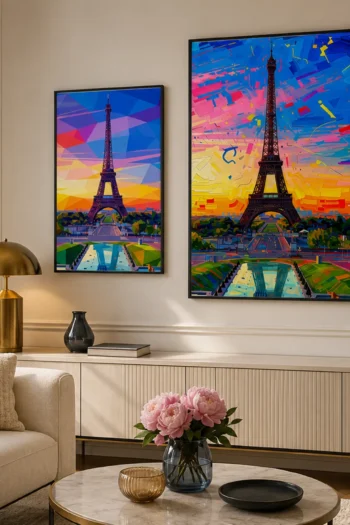
Paris in Impressionist Dream
Soft colour, atmospheric light and an elegant urban composition.
View artwork
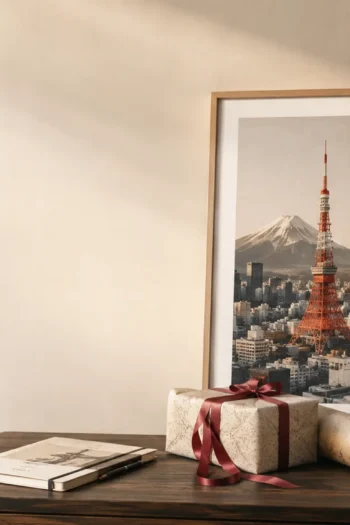
Tokyo in Japanese Tradition
A refined meeting of metropolitan architecture and Japanese balance.
View artwork
New York in Geometric Mosaic
Structured geometry for contemporary and design-led interiors.
View artwork
Rome in Urban Sketch
Architectural detail and expressive drawing in a restrained palette.
View artwork

Sydney in Aura Abstract
Layered colour and recognisable architecture interpreted abstractly.
View artworkWhy It Works
What Art Brings to a Living Room
Visual Focus
A clear focal point gives the room direction and anchors the furniture.
Personal Meaning
Cities and landmarks transform travel memories into part of daily life.
Colour Balance
Artwork can connect isolated colours and materials throughout the room.
Flexible Design
Prints can refresh an interior without changing furniture or finishes.
Designer Tips
Small Decisions that Create a More Refined Result
- Relate the artwork to the width of the furniture beneath it.
- Keep the centre of the composition close to natural eye level.
- Leave enough negative space around statement pieces.
- Use consistent spacing between works in a gallery arrangement.
- Repeat one artwork colour elsewhere in the room.
- Avoid combining too many unrelated artistic styles.
- Choose natural wood when the room needs warmth and softness.
- Test the layout with paper templates before drilling the wall.
Frequently Asked Questions
Living Room Art Print FAQ
What size art print should I hang above a sofa?
The complete artwork or group of prints should generally relate to the width of the sofa. A composition occupying roughly one-half to two-thirds of the sofa width often creates a balanced starting point.
How high should living-room artwork be hung?
Place the visual centre close to eye level and keep the lower edge connected to the furniture below. Avoid hanging the artwork so high that it appears detached from the sofa or console.
Should all frames in a living room match?
Matching frames create a clean and ordered appearance, but they are not essential. Mixed frames work when they share a colour family, material or consistent visual weight.
Can different art styles be combined in one room?
Yes. Maintain a common element such as colour, subject, scale or framing so the works feel intentionally related rather than randomly assembled.
Are framed prints better than unframed posters?
Framed prints provide a finished architectural edge and additional protection. Unframed posters create a more informal effect and can work well in creative, youthful or frequently changing interiors.