Travel & Places
Iconic Places in Rome
Explore the monuments, piazzas and architectural perspectives that have shaped the visual identity of the Eternal City.
Explore RomeThe Eternal City
A City Where Architecture Becomes Collective Memory
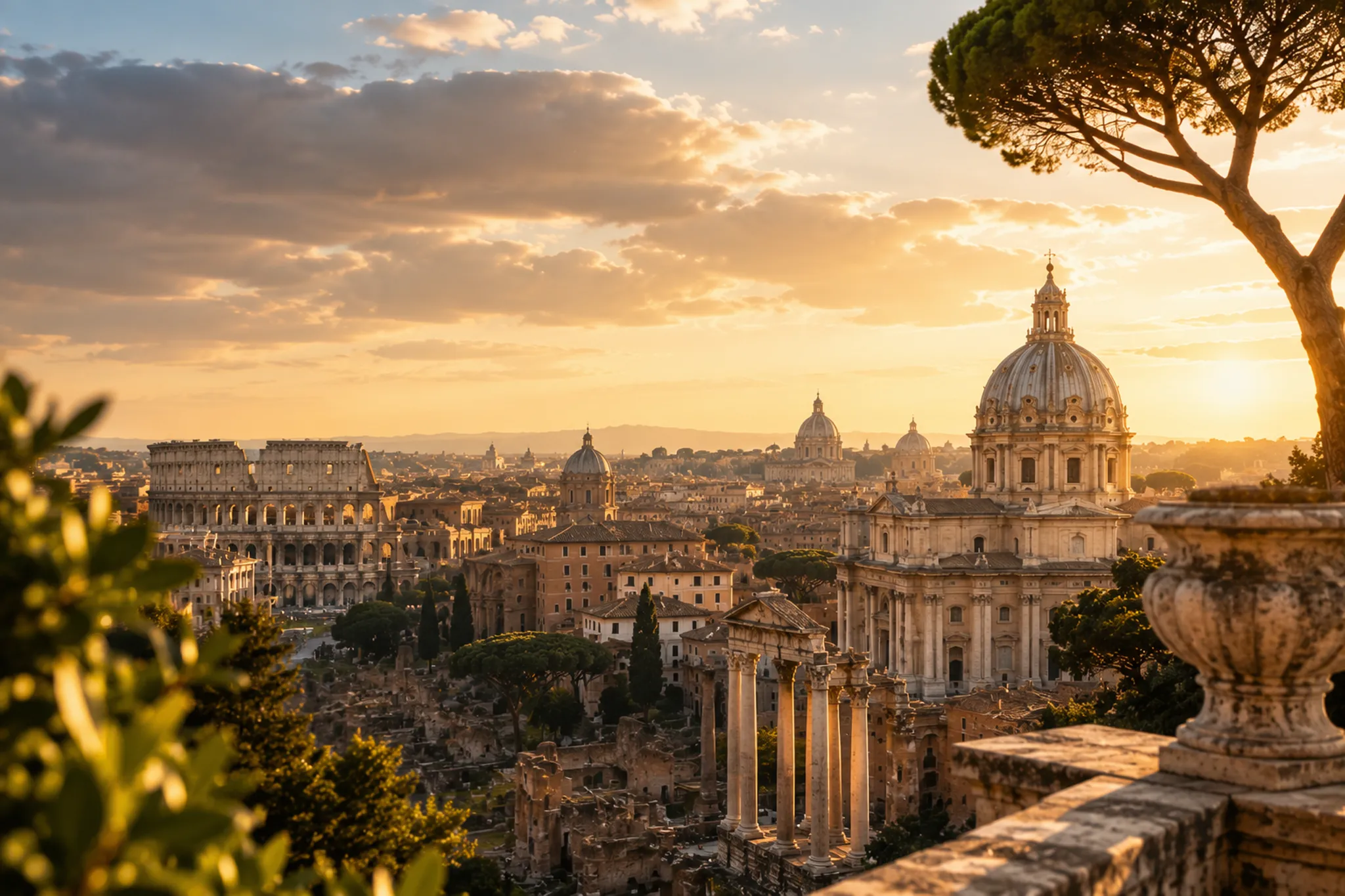
Rome is not defined by a single period or architectural language. Ancient ruins, Renaissance palaces, Baroque fountains and modern urban life exist side by side, creating one of the most recognisable cityscapes in the world.
The historic centre can be read as a sequence of layers. Columns and fragments from antiquity appear beside later churches. Medieval streets open unexpectedly onto monumental squares. Domes, obelisks and bell towers guide the eye above the dense stone fabric of the city.
Rome’s iconic places are powerful not only because of their scale or age, but because they continue to form part of everyday life. The Pantheon is approached through a busy piazza. The Trevi Fountain emerges at the end of narrow streets. The Colosseum remains visible from roads, parks and contemporary transport routes.
This constant relationship between monument and city gives Rome its extraordinary visual energy. Every viewpoint brings together different centuries, materials and human stories.
For artists, Rome offers a remarkable range of forms: the elliptical geometry of the Colosseum, the disciplined symmetry of St Peter’s Square, the theatrical movement of Baroque sculpture and the warm tonal variations of travertine, brick and aged plaster.
Essential Rome
Six Places that Define the City

The Colosseum
Rome’s most recognisable ancient monument is defined by its elliptical structure, repeated arches and extraordinary urban scale.

The Pantheon
A monumental portico conceals one of antiquity’s most influential interior spaces, organised beneath a vast concrete dome.

Trevi Fountain
Architecture, sculpture and moving water merge into one theatrical Baroque composition hidden within the surrounding streets.

The Spanish Steps
A monumental urban staircase connects Piazza di Spagna with the church of Trinità dei Monti through a sequence of terraces and curves.

Piazza Navona
The elongated form of an ancient stadium became one of Rome’s most elegant Baroque public spaces.

Castel Sant’Angelo
Originally built as an imperial mausoleum, the circular fortress has become a defining landmark on the River Tiber.
Architecture
Why Rome Looks Unlike Any Other City
Rome’s identity comes from the coexistence of complete monuments and architectural fragments. Ancient stone was reused in later buildings, streets followed earlier routes and new institutions occupied historic structures. The city therefore developed through transformation rather than replacement.
Travertine provides a recurring visual thread. Its warm pale surface appears in ancient, Renaissance, Baroque and modern buildings. Brick, marble, stucco and terracotta add deeper reds, ochres and weathered neutral tones.
Rome is also a city of controlled perspectives. Narrow streets frame domes and façades, while steps and terraces create dramatic changes in level. Fountains are positioned as architectural destinations rather than independent decorative objects.
Featured Artworks
Rome Reinterpreted through Six Artistic Languages

Rome in Japanese Tradition
Classical monuments interpreted through balance, rhythm and restraint.
View artwork
Rome in Impressionist Dream
Atmospheric light and colour inspired by the city’s changing surfaces.
View artwork


Rome in Urban Sketch
Architectural observation expressed through pencil line and texture.
View artwork
Rome in Aura Abstract
Recognisable Roman forms transformed into layered contemporary colour.
View artworkFrequently Asked Questions
Rome Landmark FAQ
What is the most famous landmark in Rome?
The Colosseum is generally regarded as Rome’s most recognisable landmark, although the Pantheon, Trevi Fountain and St Peter’s Basilica are also central to the city’s international image.
Which Rome landmarks are close to one another?
The Pantheon, Piazza Navona and Trevi Fountain can be connected on foot through the historic centre. The Colosseum and Roman Forum form another closely linked archaeological area.
What architectural styles can be seen in Rome?
Rome contains ancient Roman, early Christian, medieval, Renaissance, Baroque, Neoclassical, modern and contemporary architecture.
Why is Rome called the Eternal City?
The expression reflects Rome’s exceptional historical continuity, cultural influence and long-standing image as a city intended to endure across generations.
Why is Rome such an important subject for artists?
Rome combines monumental architecture, dramatic perspective, textured materials, strong light and visible historical layers, providing an unusually varied source of artistic inspiration.